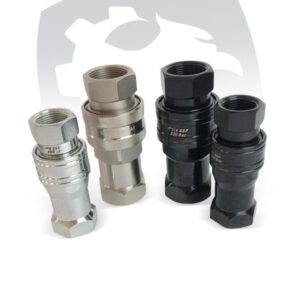
QUICK COUPLINGS

  • hızlı bağlantı kaplinleri-quick couplings-raccords rapides-acoplamientos rápidos-быстроразъёмные соединения

    QUICK COUPLINGS

    Specifications
    Flow Range 23 – 753 l/min (6.07 – 198.94 GPM)
    Max. Pressure 350 bar (5076 PSI)
    Available Sizes 1/4″ – 2″
    Body Material High Strength Carbon Steel


    These quick couplings are designed to provide fast, secure and leak-free connections in hydraulic systems. They allow easy connection and disconnection of hydraulic lines while ensuring reliable performance under demanding operating conditions.

    With Hayneks Quick Coupling series, flow capacity ranges from 23 l/min to 753 l/min (6.07 – 198.94 GPM). Available in sizes from 1/4″ to 2″, these couplings comply with ISO 7241-1 “A” standard and feature a locking ball mechanism, NBR seals and operating pressures up to 350 bar (5076 PSI).

End of content

End of content

Quick Couplings Technical Catalog

Access detailed volumetric flow charts, maximum operating pressure parameters, and interchangeability matrices for the Hayneks Quick Coupling Series.

Download Technical PDF

Global Hydraulic Excellence by Hayneks Hydraulic. Maximize the efficiency of tool swap-outs and secure leak-free high-pressure connection points with our premium HYDRAULIC QUICK COUPLINGS. Specifically engineered to withstand harsh impulse frequencies and severe mechanical vibration, the Hayneks coupling matrix features high-tensile carbon steel constructions hardened through advanced heat treatments. Offering configurations from universally standardized ISO A and ISO B poppet series to specialized non-spill Flat Face setups and ultra-duty threaded screw couplings, our assemblies prevent environmental oil spillage, eliminate system air induction, and secure maximum fluid throughput.

Hydraulic Quick Couplings: Technical FAQ

1. What international standards govern the structural design and interchangeability of Hayneks quick couplings?

Our Quick Couplings are manufactured in strict compliance with globally recognized standardizations. This includes the classic ISO 7241-1 Series A and Series B criteria for general-purpose applications, as well as the rigorous ISO 16028 dimensional frameworks governing non-spill, flat face configurations used on modern heavy attachments.

2. What are the key engineering benefits of utilizing Flat Face quick couplings over traditional poppet styles?

Flat Face (ISO 16028) couplings feature a specialized dry-break design. When disconnected, they restrict fluid leakage to near-zero drops, eliminating environmental pollution. Furthermore, their smooth surface prevents airborne dirt accumulation from entering the circuit during reconnection and reduces internal air inclusion, protecting sensitive downstream proportional valves.

3. How do threaded screw-to-connect quick couplings manage extreme high-pressure impulse cycles?

For high-impulse environments like hydraulic concrete breakers, demolition shears, and excavating hammers, standard ball-locking designs suffer from premature wear (brinelling). Hayneks Screw-Type Quick Couplings incorporate heavy-duty threaded sleeves that mechanically lock the male and female halves together, distributing structural loads evenly to handle extreme pressure spikes without accidental decoupling.

4. What material compositions and anti-corrosive surface treatments are applied to these couplings?

To resist external atmospheric oxidation and internal fluid abrasion, Hayneks couplings are machined from high-grade solid carbon steel bars. Crucial high-stress internal components undergo induction hardening. The completed parts receive an advanced Trivalent Chrome (Cr3+) or premium Zinc-Nickel plating coat, exceeding standard salt spray test benchmarks.

5. Can Hayneks quick couplings be safely coupled or uncoupled under trapped residual pressure?

Standard quick couplings require complete system decompression prior to connection. However, select configurations in the Hayneks matrix can be ordered with specialized connect-under-pressure (CUP) internal poppets. These relief mechanics safely vent localized thermal or static residual pressure during the initial mating stage, allowing operators to secure locking links without heavy manual force.

6. What sealing compounds are configured inside the coupling bodies to secure sızdırmazlık?

Our standard quick coupling solutions incorporate premium Nitrile (NBR) main seals backed by structural polyurethane anti-extrusion rings to handle rapid flow surges. For extreme operating temperatures or aggressive synthetic fluids, custom configurations can be specified with high-grade Viton (FKM) sealing matrices.

7. How does internal valve streamlining affect pressure drop (Delta P) characteristics?

Improperly designed internal poppets create localized fluid turbulence, generating excessive system heat and restriction losses. Hayneks quick couplings utilize computer-optimized, streamlined internal flow paths that maintain a wide net flow area, ensuring smooth fluid transit, low delta-P drops, and superior fuel economy for the prime mover.

8. Which mobile industrial and vocational sectors rely most heavily on quick coupling installations?

The variable quick coupling configuration is widely utilized across heavy machinery ecosystems. Key installations include skid steer loaders, heavy construction excavators managing quick-hitch tool swaps, agricultural tractors linked to row implements, industrial hydraulic rescue tools, and multi-line transport trailer connections.

9. Are Hayneks quick couplings cross-compatible with dominant global hydraulic brands?

Absolutely. Every core coupling line is structurally engineered to achieve complete dimensional and dimensional cross-compatibility with primary international OEM standard patterns. They match identical thread patterns, sleeve diameters, and nose lengths, functioning as reliable 1:1 mechanical drop-in replacements.

10. What preventive fleet maintenance protocols ensure the extended lifespan of quick couplers?

To avoid abrasive particles from scoring the internal seals and inducing leakage, operators should always deploy protective dust caps and plugs when halves are uncoupled. Additionally, mechanics should visually wipe the coupling faces clean before mating and verify internal seal integrity every 250 operating hours.

Adress

Hardoks Industrial Site, Fevzi Çakmak Neighborhood, Ahmet Petekçi Street No: 15B, Karatay, 42050 Konya, TURKEY

2025 Hayneks Hydraulic. All Rights Reserved.