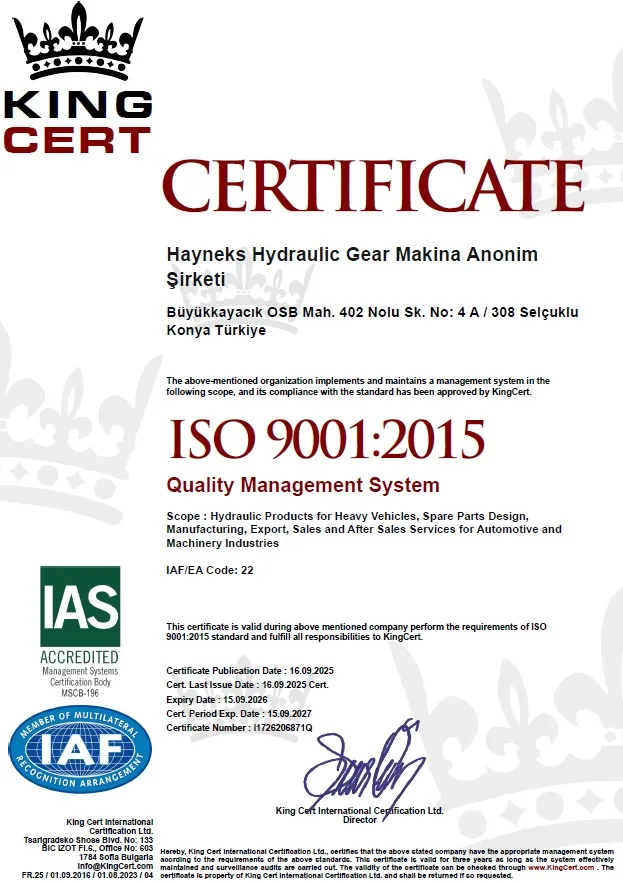
At Hayneks Hydraulic, we supply precision-engineered PTO systems and pumps to fleets worldwide. In the demanding world of heavy-duty mobile hydraulics, industrial machinery, and commercial vehicles, power transmission relies entirely on the heart of the system: the hydraulic pump. When a system’s flow and pressure requirements exceed the physical limitations of standard gear or vane pumps, hydraulic engineers consistently turn to Fixed Flow Bent Axis Piston Pumps.
Characterized by their incredibly compact footprints, exceptional volumetric efficiency, and the ability to withstand immense peak pressures (up to 500 bar), bent axis piston pumps are the absolute standard for heavy-duty cranes, fire rescue vehicles, multi-axle dump trucks, and heavy-tonnage transporters.
In this comprehensive engineering guide, we will break down the precise mechanics of bent axis piston pumps. Utilizing technical data from the Hayneks Hydraulic catalog, we will explore the capabilities of our pump series ranging from the agile 35cc to the massive 105cc models alongside crucial fluid specifications and professional assembly procedures designed to maximize your system’s lifespan.

What is a Bent Axis Piston Pump and How Does It Work?
A bent axis piston pump is a type of positive displacement hydraulic power unit. It generates fluid flow and pressurization through the reciprocating (back-and-forth) axial movement of pistons within a machined cylinder block.
The defining characteristic of this pump is its «Bent Axis» design. Unlike inline axial pumps that use a swashplate to drive the pistons, a bent axis pump features a permanent angle (typically between 25 and 40 degrees) between the drive shaft and the cylinder block. The rotational energy from the vehicle’s Power Take-Off (PTO) or an industrial electric motor drives the shaft, which in turn moves the pistons inside the angled cylinder block.
- The Suction Phase: As the cylinder block rotates, the pistons are pulled outward from their bores on the low-pressure side of the cycle. This creates a powerful vacuum, drawing mineral-based hydraulic oil into the pump.
- The Pressure Phase: As rotation continues into the high-pressure side, the angled geometry forces the pistons back into the cylinder block. This mechanical kinematic force compresses the hydraulic fluid and pushes it out through the discharge port at extreme pressures—reaching peak levels of 450 to 500 bar
The Pressure Phase: As rotation continues into the high-pressure side, the angled geometry forces the pistons back into the cylinder block. This mechanical kinematic force compresses the hydraulic fluid and pushes it out through the discharge port at extreme pressures—reaching peak levels of 450 to 500 bar.
This angled design inherently minimizes the lateral loads and side friction placed on the pistons. As a result, bent axis pumps can safely achieve much higher rotational speeds (RPM) and sustain significantly higher continuous pressures than alternative pump designs, all while maintaining a volumetric efficiency of over 95%.
Premium Anatomy and Component Quality

A hydraulic pump’s ability to survive in brutal field conditions is entirely dependent on the metallurgical quality of its internal components. Hayneks bent axis piston pumps are engineered for extreme longevity and zero-leakage performance under severe duty cycles. An internal breakdown reveals the following high-tier engineering standards:
- Heavy-Duty Bearings: To absorb the massive axial and radial loads generated at 500 bar, the housing is equipped with heavy-duty tapered roller bearings, specifically the 31308 X and 32007 X series.
- Universal Shaft Standards: Ensuring seamless compatibility with global PTOs and gearboxes, these pumps feature splined shafts machined to the strict SHAFT 8x32x35 DIN 5462 standard.
- Advanced Sealing Technology: Preventing oil bypass at 7,251 PSI requires elite sealing. The assemblies utilize high-temperature-resistant O-Rings (sizes such as 90×2, 61.2×2.62, and 84.52×2.62) and premium 35x52x6 oil seals.
- Reinforced Housing: To prevent the pump casing from flexing or fracturing under extreme hydrostatic pressure, the monoblock body and precision-machined piston beds are cast and hardened to military-grade specifications.
The Hayneks Bent Axis Series: Technical Capacity Analysis
Whether you are designing a hydraulic circuit for a compact tipper trailer or a continuously operating heavy recovery winch, matching the exact displacement (Liters/Minute) and maximum pressure (Bar) to your application is mandatory. As the internal volume (cc) of a pump increases, the mass of the moving internal components also increases. Consequently, the maximum allowable rotational speed (RPM) and peak pressure tolerances must be slightly reduced to prevent overheating and centrifugal damage.
Based on our technical catalog, here are the global operating parameters for our fixed flow bent axis series:
The 35cc and 45cc Series (High Speed & High Pressure)
- 35 Liter Model (Codes: 35203531 / 35203532): This highly agile unit delivers a displacement of 35.40 L/min. It boasts a maximum continuous speed of 2400 RPM. It operates at a continuous pressure of 450 Bar (6526 PSI) and can withstand explosive peak pressures of 500 Bar (7251 PSI). Despite this immense power, it weighs only 7.70 kg.
- 45 Liter Model (Codes: 35204531 / 35204532): Providing a slightly higher displacement of 45.60 L/min, this model operates at a maximum continuous speed of 2100 RPM. It maintains the identical extreme pressure tolerances of the 35cc model (450 Bar continuous / 500 Bar peak), making it ideal for compact yet demanding lifting applications
The 65cc and 85cc Series (Balanced Power & Mid-High Flow)
- 65 Liter Model (Codes: 35206531 / 35206532): Generating a flow of 63.20 L/min, this pump hits the «sweet spot» for standard heavy machinery. It features a maximum continuous speed of 2000 RPM. It retains the 450 Bar continuous and 500 Bar peak pressure ratings, while the physical weight increases to 10.00 kg.
- 85 Liter Model (Codes: 35208531 / 35208532): Stepping into the heavy-flow category, this unit delivers 85.10 L/min. Due to the larger internal rotating mass, the maximum continuous speed is calibrated to 1900 RPM. The continuous pressure rating is 400 Bar (5801 PSI) with a peak pressure tolerance of 450 Bar. The unit weighs 12.50 kg.
The 105cc Series (Maximum Flow for Heavy Tonnage)
- 105 Liter Model (Codes: 35210531 / 35210532): The largest displacement pump in the series, delivering a massive 105.70 L/min. This model is engineered for heavy equipment requiring rapid cylinder actuation. Its maximum continuous speed is 1700 RPM. It reliably sustains a continuous pressure of 350 Bar (5076 PSI) and can handle peak pressure spikes up to 400 Bar (5801 PSI).
Across all models, the Oil Inlet ports range from R1 1/4″ to R1 1/2″, while the high-pressure Oil Outlet ports range from R 3/4″ to R 1″ to ensure optimal fluid velocity and system safety.
Operating Conditions and Critical Fluid Management
A bent axis piston pump is a high-tech instrument with internal clearances measured in microns. Because of this, the hydraulic fluid is not just a medium for power transfer it is the single most important structural component of your system.
- Fluid Type: Systems must exclusively use high-quality, anti-foaming Mineral-Based Hydraulic Oil with a high viscosity index. Never substitute with automatic transmission fluid (ATF), standard motor oil, or recycled agricultural oils.
- Ideal Operating Temperature: Volumetric efficiency is highest, and the protective lubrication film is most stable, when the oil temperature is strictly maintained between 50°C and 60°C (122°F – 140°F).
- Maximum Temperature Limits: Under heavy operational loads, oil naturally heats up. However, the system temperature must never exceed the 0°C to 80°C (32°F – 176°F) boundary. Pushing oil past 80°C permanently degrades its chemical structure, dropping its viscosity to that of water. This results in catastrophic metal-to-metal friction and instantly melts the high-pressure O-rings (such as the 61.2×2.62 and 84.52×2.62 seals).
Expert Installation and Assembly Best Practices
Even the finest hydraulic pump will violently destroy itself within ten minutes if installed incorrectly. Technicians and fleet mechanics must adhere to the following strict installation rules:
1. Identifying the Rotation Direction (Critical Step)
Before bolting a pump to a vehicle, you must verify the rotation direction. The pump’s rotation must always be the exact opposite of the Power Take-Off (PTO) shaft’s rotation. Hayneks manufactures dedicated models for both directions:
- CW (Clockwise / Right): e.g., Model Code ending in ’31’ (35203531).
- CCW (Counter-Clockwise / Left): e.g., Model Code ending in ’32’ (35203532). Warning: If you install a CW-rotating pump onto a CW-rotating PTO, the pump cannot create suction. It will run completely dry, and the internal roller bearings will burn out and seize within seconds.
2. Plumbing and System Cleanliness
Particulate contamination is the number one killer of piston pumps. Before attaching suction and pressure hoses, ensure the entire hydraulic circuit is flawlessly clean and free of welding slag, rust, or dust. The protective caps over the pump’s oil inlet/outlet should only be removed at the exact moment you are ready to thread the fittings.
3. Filtration and The «Cold Start» (Bleeding)
- The suction or return line must feature a high-quality hydraulic filter rated for a flow capacity exceeding the pump’s maximum output (e.g., use a 150 L/min filter for a 105cc pump).
- After mounting the pump, fill the reservoir and allow the system to rest, bleeding out trapped air so gravity feeds oil directly into the pump housing.
- The initial «Cold Start» should be conducted at engine idle without applying any load to the cylinders. Listen closely; if you hear high-pitched whining (cavitation) or grinding, disengage the PTO immediately and inspect the fluid lines.
Troubleshooting Common Issues
Even well-designed systems can experience field issues. Here are the engineering solutions to common symptoms:
- 1. The Pump Emits a High-Pitched Whining Noise (Cavitation):
- Cause: The pump is starving for fluid, creating vapor bubbles that explode against the internal metal (cavitation).
- Solution: The suction hose is likely too narrow, or the suction filter is clogged. Cold weather can also thicken the oil, making it too viscous to flow properly. Ensure your inlet hoses meet the exact dimensions specified in the catalog.
- 2. The System Fails to Build Pressure or Lift Heavy Loads:
- Cause: The rotational RPM is too low, or the system’s relief valve is opening prematurely, dumping pressure back into the tank.
- Solution: Verify that the PTO is outputting the correct RPM (minimum intermittent speed is usually 300 RPM). Recalibrate the relief valve. Additionally, check if the internal seal washers (61.7x50x2) have failed due to previous overheating
- 3. Oil Leaking from the Housing or Shaft Seals:
- Cause: The pump has been forced to operate above its maximum peak pressure limit (e.g., exceeding 500 Bar) or driven past its maximum RPM limit.
- Solution: Replace the primary oil seal (35x52x6) and front cover O-Rings. To prevent future blowouts, install a hydraulic accumulator in the circuit to absorb sudden pressure spikes and hydraulic shock.

Frequently Asked Questions (FAQ)
-
What is the main difference between a Bent Axis Pump and a Gear Pump?
While standard gear pumps generally max out around 250 to 280 bar, bent axis piston pumps utilize their angled kinematic design to safely sustain immense pressures between 450 and 500 bar, while delivering superior volumetric efficiency.
-
Can these pumps be driven by an electric motor instead of a PTO?
Yes. As long as you use an appropriate mechanical coupling that matches the DIN 5462 splined shaft, and ensure the electric motor provides the required torque and matches the pump’s CW/CCW rotation, these pumps are exceptional for stationary industrial applications.
-
Why is it so dangerous for the oil to exceed 80°C?
Temperatures above 80°C (176°F) cause «viscosity breakdown.» The oil becomes too thin to maintain a protective lubrication film between the rapidly moving pistons and the cylinder block, leading to catastrophic metal-to-metal friction and the melting of internal sealing O-rings.
-
Why does the 105cc pump have a lower maximum RPM than the 35cc pump?
This is due to the laws of physics. The larger internal volume (105cc) requires much heavier pistons and a larger cylinder block. Moving this heavier mass at extreme speeds generates excessive centrifugal force and heat. Therefore, the 105cc is limited to 1700 RPM, while the lighter 35cc can safely spin at 2400 RPM.
-
What specific type of oil should I use?
To maximize the lifespan of your bent axis pump, exclusively use premium «Mineral-Based Hydraulic Oil». Choose the specific viscosity grade (e.g., ISO 32 or ISO 46) based on the seasonal ambient temperature of your operating environment.
Engineer Your Operations for Unbreakable Reliability
When you are lifting critical loads or running continuous heavy-duty operations, a hydraulic pump failure is an unacceptable loss of time, money, and reputation. Fixed Flow Bent Axis Piston Pumps are engineered specifically to eliminate these risks, offering unparalleled 500-bar pressure tolerances and rugged DIN 5462 shaft construction.
Fully compatible with all major global gearboxes and PTO systems, our comprehensive range of 35cc, 45cc, 65cc, 85cc, and 105cc hydraulic pumps will provide your fleets and industrial facilities with the relentless power they require.
- Unsure about flow rate calculations or torque requirements for your specific hydraulic circuit?
- 🚀 Request a Custom Global Quote: Contact our team for project-specific pricing and international shipping logistics.
- 📂 Download the Technical Catalog: Review highly detailed dimensional drawings and performance diagrams for our entire piston pump lineup.
- 📞 Speak with Our Engineers: Get expert assistance from the Hayneks engineering team to determine the optimal CW/CCW rotation, mounting adaptations, and fluid management requirements for your heavy-duty applications.
Powering Your Operations with Hayneks Hydraulic
Your heavy-duty machinery is only as strong as its hydraulic heart. Compromising on pump quality or installation protocols directly leads to catastrophic downtime and lost revenue. By selecting the precisely engineered fixed flow bent axis piston pump for your system, you are investing in the long-term reliability of your entire fleet.
For world-class engineering, uncompromising durability, and global technical support, trust Hayneks Hydraulic. Whether you need a robust 35cc unit or a massive 105cc powerhouse, our solutions are built to keep your operations moving. Explore our complete catalog today, and let our precision-crafted hydraulic systems drive your success forward.